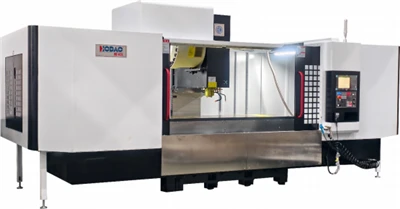
If you’ve ever stood next to a 5 axis machining center mid-run, you’ll probably notice a lot going on—spindles humming, axes rotating, chips flying everywhere. Most folks fixate on the cool, precise cuts those machines make, but the unsung hero that keeps everything running without downtime is the chip management system. As someone who’s been supplying 5 axis machines for 12 years now, I can’t tell you how many customers come to me complaining about messy shops or constant production pauses, only to realize their chip system was either undersized or not set up for 5 axis-specific challenges. 5 Axis Machining Center

Let’s break this down plain and simple, no overengineered jargon—what makes a 5 axis chip management system different from your basic 3 axis setup? For starters, 5 axis machines tilt or rotate the workpiece or spindle, so chips don’t just fall straight down like they used to on older machines. Those little metal shavings catch on angled workpieces, get trapped in the gap between rotary tables, or get flung into hard-to-reach corners before they even hit the conveyor. A standard 3 axis conveyor that works fine for a mill might clog up in a week on a 5 axis machine—we’ve seen that happen dozens of times.
First up, the core workhorses of most 5 axis chip systems: the chip conveyors. But not just any conveyors. There are a couple main types we spec for our machines, depending on what the shop is making. The most common one for 5 axis setups is the hinged steel belt conveyor. These have interlocking metal plates that can handle thick, heavy chips from parts like aerospace turbine blades or automotive engine blocks, and they’re angled just right to match the 5 axis machine’s bed, so even tilted workpieces don’t dump chips in the middle of the floor. We always make sure to size these conveyors 20% larger than the machine’s baseline needs, because 5 axis operations often generate way more chips than operators plan for—people tend to underestimate how much material gets cut when you’re machining complex, multi-sided parts.
Then there’s the auger conveyor, which is great for smaller, finer chips—like when you’re machining aluminum housings or medical device parts, where shavings are thin, stringy, and super easy to clog. Augers twist through a tube to push chips out, and we add screen filters to catch any coolant that comes along with the chips, so shops can recycle that coolant instead of wasting it. The trick here is matching the auger diameter to the chip size—too small, and it will jam every hour; too big, and it’s overkill, wasting energy. We walk customers through their typical parts all the time to nail that balance.
Wait, and let’s not forget about the machine’s internal chip management features, not just the external conveyors. The biggest one for 5 axis is the high-pressure coolant through the spindle, or TSC (through-spindle coolant). No, this isn’t just for cooling the tool—it blasts chips right off the cutting edge and out of the work zone, even when the spindle is tilted 90 degrees. On a standard 3 axis machine, you might get away with a few external nozzles, but when the workpiece is rotated, external nozzles can’t reach every spot. TSC is non-negotiable for shops doing 5 axis work; without it, chips will get embedded in the workpiece, ruining a $10,000 part faster than you can hit reset. We always include high-flow TSC as an option on all our 5 axis machines, and 9 out of 10 customers go for it once they see the difference.
Next, the rotary table chip guards—this is a huge weak spot a lot of new shops miss. 5 axis machines have A (tilt) and B (rotate) axes, so there’s that big gap between the rotary table surface and the machine’s frame. Chips get stuck in there, and if they build up, they can scratch the table, jam the axis, or even throw off the machine’s precision by a few microns. That’s why we spec wipers and gap covers for all our 5 axis setups—wipers are little rubber or steel blades that sweep the rotary table surface every time it rotates, and gap covers are flexible, heat-resistant panels that close up the gaps when the axis is moving. I’ve seen a shop skip the gap covers once, and in three months they had to replace a $2,000 rotary axis bearing because of embedded chips. Never again.
Then there’s coolant filtration, which ties straight into chip management. If your coolant is full of tiny chip particles, it won’t cool the tool right, and those particles can get ground into the workpiece surface. For 5 axis machines, we usually use two-step filtration: first a magnetic separator that pulls out ferrous chips (steel, iron) right when they’re generated, then a bag or cartridge filter that catches the finer non-ferrous chips (aluminum, copper). Some of our larger customers go with centrifugal filters, which spin the coolant at high speed to separate chips, and they last way longer than disposable filters—less downtime changing filters is a win for any production floor.
Wait, let’s talk about common mistakes customers make with 5 axis chip systems. One big one is reusing a 3 axis conveyor for a 5 axis machine. A buddy of mine runs a machine shop that tried that a couple years back—their 3 axis conveyor was only 12 inches wide, and when they started machining aerospace parts on their new 5 axis, chips kept piling up on the conveyor’s edge and spilling all over the floor. They ended up replacing it with a 18-inch wide hinged belt conveyor, and their cleanup time dropped by 80%. Another mistake is not emptying the chip hopper often enough. 5 axis machines can generate a ton of chips in a single run—if the hopper is full, chips will back up into the machine and cause a crash. We always set up a timer for automatic hopper emptying, so it never gets too full, even if operators are running another part nearby.
Oh, and there’s a fun little add-on we’ve been pushing lately: chip compactors. If a shop is generating a lot of small chips, compacting them into briquettes cuts down on disposal costs a lot. We worked with a medical device shop last year that was paying $500 a month to haul away aluminum chips, and after adding a chip compactor, their disposal cost dropped to $150. It pays for itself in 6 months, easy. Plus, compacted chips are way easier to recycle, which is a big plus for shops focused on sustainability.
Now, let’s tie this back to why this matters for your operation. A 5 axis machining center is a big investment—you don’t want it sitting idle because of a chip system that can’t keep up. When we supply a machine, we don’t just drop it off and leave; we walk the customer through every part of the chip system. We’ll ask them: what kind of materials are you machining? What’s the typical part size? How many runs do you do a day? All that info helps us pick the right conveyors, filtration, and add-ons so they don’t have to retrofit later. I’ve seen too many shops cut corners on chip systems, and it’s always a headache down the line.
If you’re in the market for a 5 axis machine, don’t just ask about spindle speed or axis travel—ask about the chip management system. Make sure it’s designed specifically for 5 axis, not just a 3 axis system shoved into a bigger frame. Ask if it has TSC, rotary table wipers, and sized conveyors. And if you’re not sure what you need, reach out to talk it through. At the end of the day, the best precision in the world doesn’t matter if a pile of chips brings your production to a stop.
If you’re ready to upgrade your machining setup or just want to chat about what chip system would work for your shop, get in touch to discuss your needs. We’re here to help you keep chips moving and your machine running smoothly.
Profile Machine References
- Industrial Machinery Digest. (2022). “Chip Management Systems for Multi-Axis Machining Centers.” Industry Insights Quarterly.
- Makino Manufacturing. (2021). 5 Axis Machining Efficiency: Chip Removal Best Practices. Technical Whitepaper.
- Gardner, J. (2023). “Common Downtime Causes in Multi-Axis Machining and Solutions.” Journal of Manufacturing Operations.
- Haas Automation. (2022). Chip Handling for High-Volume 5 Axis Production. Application Note.
- Modern Machine Shop. (2023). “Sustainability in Machining: Chip Recycling and Disposal Strategies.” Shop Floor Trends.
Taizhou Qiyang Trading Co., Ltd.
As one of the most professional 5 axis machining center manufacturers and suppliers in China, we’re featured by quality products and good price. Please rest assured to buy bulk 5 axis machining center for sale here and get quotation from our factory. Customized orders are welcome.
Address: Zhenhai Village, Binhai Town, Wenling City, Taizhou City, Zhejiang Province
E-mail: qycncmachine@outlook.com
WebSite: https://www.qycncmachine.com/
